Description
What is a Ring Type Load Cell?
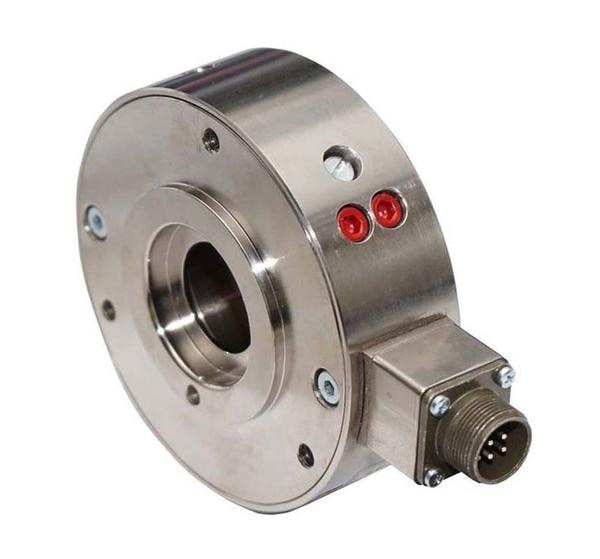
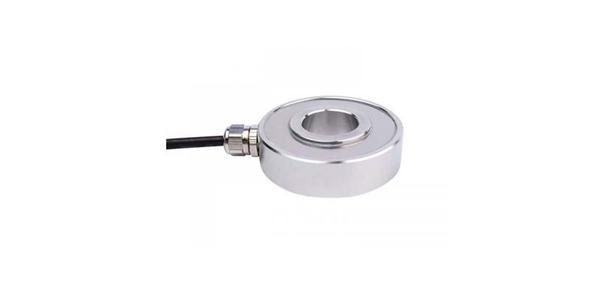
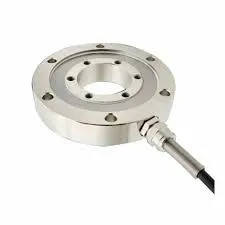
A ring type load cell, also known as a donut load cell or through-hole load cell, is a specialized force transducer with a circular, donut-like shape and a central hole. This hole allows the load cell to be installed around bolts, rods, or shafts, enabling direct measurement of axial compression forces. These load cells are especially useful when force needs to be measured around a mechanical component that passes through the sensor.
Ring load cells are designed to measure compression-only forces, although some models may be configured for limited tension applications depending on design and mounting.
How Ring Load Cells Work
Ring type load cells generally use strain gauge technology to measure deformation caused by applied force. Here's how the process works:
Force Application: A compressive force is applied through the central hole, pressing down on the sensor’s inner and outer rings.
Strain Measurement: Strain gauges bonded to strategic locations on the load cell measure the minute deformations in the metal body as force is applied.
Electrical Signal Output: The changes in resistance of the strain gauges are converted into an electrical signal, which is then processed and calibrated to represent the applied load accurately.
Most ring type load cells are constructed using stainless steel or aluminum alloys, providing excellent durability and corrosion resistance.
Key Features of Ring Type Load Cells
Compact, Low-Profile Design: Ideal for installations with limited vertical space.
Central Through-Hole: Enables axial load measurement around shafts, bolts, or tie rods.
High Capacity Range: Typically available from a few kilograms to several tons.
High Accuracy: Suitable for precision force measurement applications.
Robust Construction: Made from durable materials to withstand harsh environments.
Multiple Mounting Options: Flat, recessed, or flanged designs available for diverse applications.
Applications of Ring Type Load Cells
Ring type load cells are used across various industries due to their unique shape and versatility. Common applications include:
1. Bolt Force Measurement
These sensors are widely used to monitor preload forces in bolts, ensuring that fastening systems are tightened to the correct specifications. By placing the load cell under the bolt head or nut, accurate clamping force can be monitored in real time.
2. Press Force Monitoring
In hydraulic and mechanical presses, ring load cells are mounted to measure compressive forces during forming, stamping, or molding processes.
3. Automotive Component Testing
Ring load cells are frequently used in automotive R&D for testing components such as suspension systems, engine mounts, and transmission parts under load.
4. Material Testing Machines
Used in tensile and compressive testing systems to measure force applied to various materials and components.
5. Industrial Automation
In robotics and automated production lines, ring load cells help monitor pressing, clamping, and assembling forces, enhancing quality control and safety.
6. Aerospace and Defense
Ring load cells support structural testing and force monitoring in aircraft, missiles, and space applications where compact, high-accuracy sensors are crucial.
Benefits of Using a Ring Type Load Cell
✔️ Space-Saving Design
Thanks to the central hole and low-profile structure, ring load cells are ideal for compact systems where vertical space is limited.
✔️ Direct Axial Force Measurement
Unlike traditional load cells, ring types allow for accurate measurement of axial compression directly around bolts or rods.
✔️ High Accuracy and Repeatability
Modern ring load cells provide precise, repeatable measurements, making them suitable for critical quality control applications.
✔️ Wide Range of Capacities
Whether for lightweight applications or heavy-duty industrial systems, ring load cells come in a wide variety of capacity ranges.
✔️ Durable in Harsh Environments
With stainless steel construction and optional environmental sealing (IP65, IP67, or higher), these sensors are designed for rugged use.
Important Considerations When Choosing a Ring Load Cell
When selecting a ring type load cell, consider the following factors to ensure optimal performance and integration:
1. Load Capacity
Choose a sensor that fits your expected load range. A margin of 20–30% above your maximum load is generally recommended to avoid overload damage.
2. Inner Diameter
The central hole size should be large enough to accommodate bolts or rods while maintaining proper force distribution.
3. Outer Diameter and Height
These dimensions are critical for space-constrained applications. Make sure the load cell fits your mechanical layout.
4. Mounting Configuration
Some ring load cells include mounting holes or flanges; others require custom fixturing. Ensure compatibility with your equipment.
5. Output Signal
Standard output is mV/V (millivolts per volt), but many models are available with integrated signal conditioners for analog (4–20 mA, 0–10 V) or digital (USB, RS-485) output.
6. Environmental Conditions
If the application involves high temperature, humidity, dust, or chemical exposure, select a load cell with appropriate IP rating and corrosion-resistant materials.
7. Calibration
Look for load cells that are factory-calibrated with NIST-traceable certificates, especially if used in regulated or quality-sensitive industries.
Calibration and Maintenance
Regular calibration is essential for maintaining accuracy. It's recommended to calibrate ring load cells:
Upon initial installation
After exposure to overload or impact
Periodically (every 6–12 months, depending on use)
Routine maintenance includes:
Inspecting for physical damage or corrosion
Checking for cable integrity
Verifying zero-load signal and drift
ring type load cell
donut load cell sensor
through-hole load cell
compression load cell with center hole
ring force sensor
axial compression load cell
bolt force measurement sensor
stainless steel ring load cell
low-profile compression sensor
high-capacity ring load cell
Incorporating these keywords naturally within headings, meta descriptions, alt texts, and throughout your content can improve search engine visibility.
Conclusion
Ring type load cells are indispensable tools for compact, high-accuracy force measurement in compression applications. Their unique donut shape allows them to measure axial loads directly through a central hole, making them especially valuable in applications like bolt force monitoring, press control, and structural testing.
With a wide range of sizes, capacities, and output options, ring load cells offer engineers and designers a reliable solution for many force sensing challenges. When chosen and installed correctly, they deliver long-term precision, reliability, and integration flexibility across industries.
We are also supply in Andhra Pradesh, Arunachal Pradesh, Assam, Bihar, Chhattisgarh, Goa, Gujarat, Haryana, Himachal Pradesh, Jharkhand, Karnataka, Kerala, Madhya Pradesh, Maharashtra, Manipur, Meghalaya, Mizoram, Nagaland, Odisha, Punjab, Rajasthan, Sikkim, Tamil Nadu, Telangana, Tripura, Uttar Pradesh, Uttarakhand, and West Bengal