High-Precision Load Cells for Aerospace in Spacecraft & Satellite Testing
In aerospace engineering, precision is non-negotiable. Whether measuring the multi-million-pound thrust of a primary rocket engine or monitoring micro-vibrations across sensitive satellite solar arrays, force measurement dictates mission success or catastrophic failure.
High-precision load cells serve as the primary sensory interface during design, ground qualification, and pre-launch verification. This guide examines how aerospace-grade load cells operate under extreme environments, their critical applications in spacecraft and satellite testing, and key selection criteria for mission-critical reliability.
The Critical Role of Force Measurement in Space Systems
Space hardware undergoes brutal structural dynamics: acoustic loads exceeding 140 dB, severe shock loads during staging, and rapid thermal cycling across hundreds of degrees. Ground qualification requires replicating these forces with absolute metrological traceability.
Aerospace engineers rely on load cells to:
- Verify structural design margins against finite element analysis (FEA) predictions.
- Determine mass properties, including center of gravity (CG) and moment of inertia (MOI).
- Characterize static and dynamic thrust profiles of chemical and electric propulsion systems.
- Validate separation systems, fairing jettisons, and deployable payload mechanisms.
Key Testing Applications in Spacecraft and Satellites
1. Rocket Engine & Thruster Testing
Ground test stands utilize multi-axis load cells to capture dynamic thrust vectors ($F_x$, $F_y$, $F_z$) and induced moments ($M_x$, $M_y$, $M_z$). These sensors quantify:
- Thrust transient response: Transient startup and shutdown impulse spikes.
- Gimbaling dynamics: Mechanical vector control forces during steering maneuvers.
- Electric propulsion impulse: Micronewton-level resolution for Hall-effect and ion thrusters.
2. Satellite Mass Properties & CG Alignment
Improper mass distribution causes uncorrectable attitude drift during orbital maneuvers. High-accuracy platform load cells determine:
- Center of gravity (CG) coordinates to within fractions of a millimeter.
- Overall vehicle wet and dry mass prior to integration onto the launch adapter.
- Dynamic unbalance during high-speed spin balancing.
3. Static Load & Structural Qualification
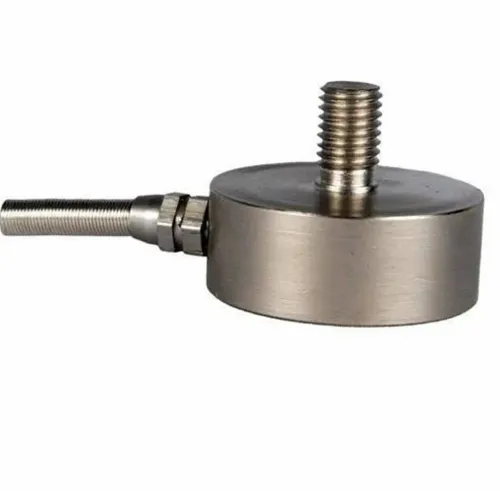
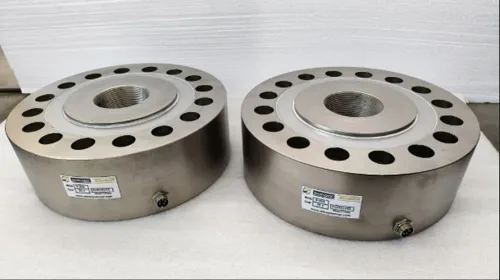
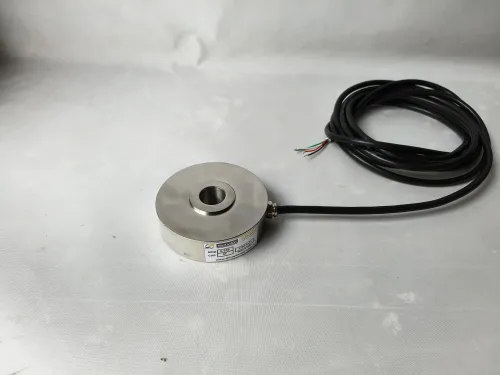
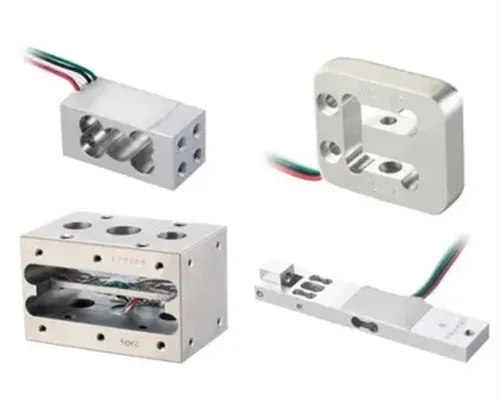
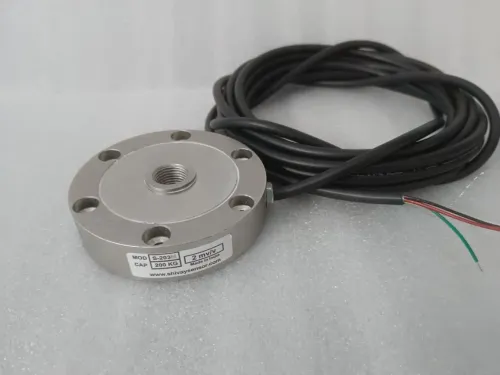
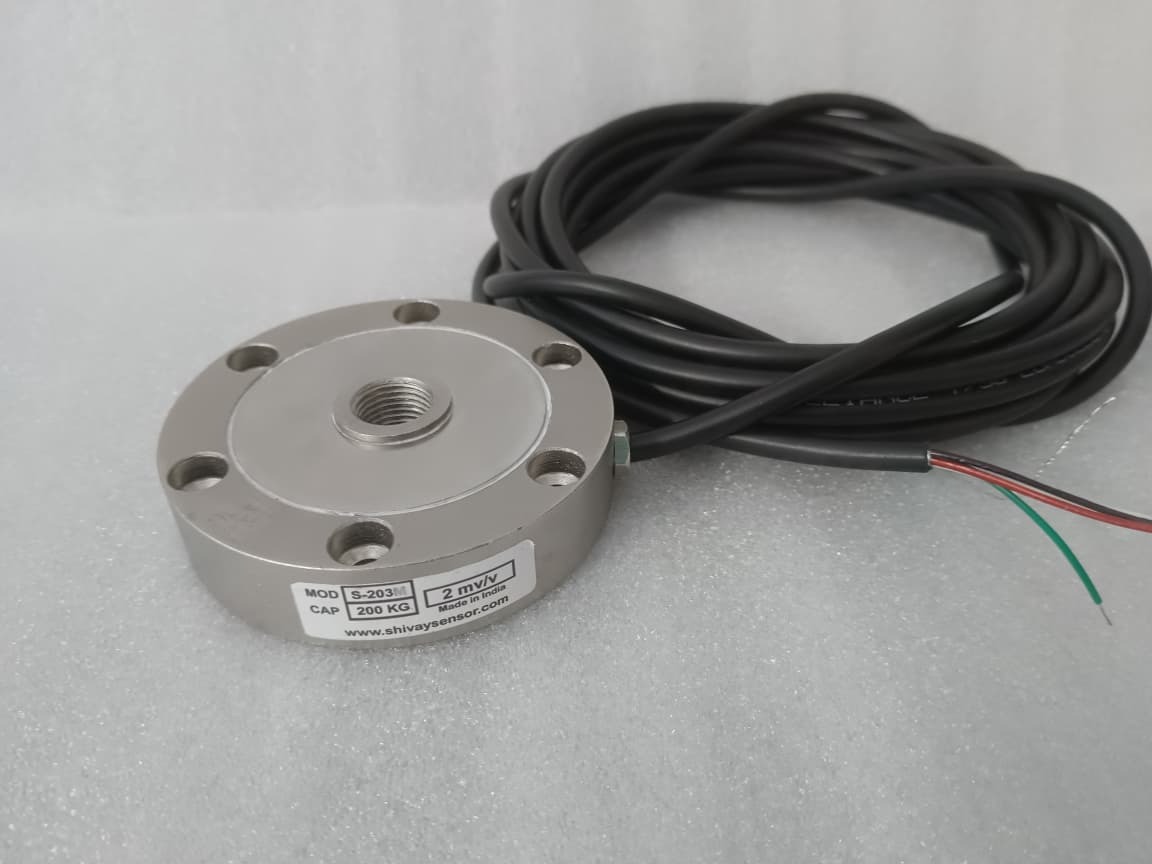
Static test fixtures use hydraulic actuators instrumented with canister or pancake (low-profile) load cells to pull, push, and twist airframe assemblies. These tests prove that primary structures withstand $1.25times$ to $1.5times$ limit loads (Design Yield and Ultimate Load criteria) without permanent deformation or structural failure.
4. Solar Array & Antenna Deployment Verification
Deployables must unfurl reliably in zero gravity using low-torque springs or micro-motors. Reaction torque sensors and low-range load cells measure:
- Hinge friction and deployment force curves.
- End-of-travel latching shock.
- Residual preload to prevent unwanted orbital oscillations.
Technical Comparison: Aerospace Load Cell Architectures
Sensor ArchitectureTypical Measurement RangePrimary Aerospace Use CaseKey AdvantageLow-Profile / Shear Web (Pancake)5 kN to 1,000+ kNStructural static load testing, launch vehicle stage testingHigh side-load rejection, low off-axis sensitivityMulti-Axis (6-DoF) Force Sensors10 N to 250 kN ($F_{xyz}$), 1 Nm to 10 kNm ($M_{xyz}$)Thruster vectoring, wind tunnel testing, robot armsSimultaneous 3-axis force and 3-axis torque trackingCanister / Column Load Cells100 kN to 5,000+ kNHeavy rocket test stands, pad weight measurementCompact footprint for ultra-high compressive capacitiesPiezoelectric Dynamic Sensors1 N to 50 kNShock testing (pyrotechnic separation), modal analysisNear-instantaneous rise time, exceptional dynamic stiffness
Navigating Extreme Aerospace Environments
Aerospace-grade force sensors differ fundamentally from industrial load cells due to the environmental stresses they endure during testing:
- Cryogenic & Elevated Temperatures: Testing near liquid oxygen (LOX at -183°C) or near rocket plumes requires specialized strain gages with compensated thermal zero shift and specialized foil alloys (such as Karma or Platinum-Tungsten).
- Thermal Vacuum (TVAC) Compatibility: Outgassing materials in low-pressure chambers can deposit volatile condensable material (CVCM) onto optical mirrors and solar cells. Space-grade load cells require hermetic sealing (welded Inconel or 17-4 PH stainless steel) and low-outgassing cables compliant with NASA SP-R-0022A.
- Stray Magnetic Fields: Electric propulsion systems (e.g., magnetoplasmadynamic and Hall thrusters) generate heavy magnetic fields that can induce signal noise in standard piezoresistive bridges; non-magnetic construction and shielded differential wiring are essential.
Key Considerations for Selecting Space-Grade Load Cells
When selecting or specifying load cells for satellite and launch vehicle testing, prioritize the following parameters:
- Combined Error / Linearity: Look for non-linearity and hysteresis figures below $pm0.05%$ full scale (FS) for flight-critical ground tests.
- Crosstalk Rejection: For multi-axis sensors, ensure decoupling algorithms and structural designs keep inter-axis crosstalk below $1.0%$.
- Overload Ratings: Standard ratings of 150% FS are standard, but test stands subject to water-hammer spikes or rapid ignition transients often require safe overload protection up to 300% to 500% FS.
- Calibration Traceability: Verify ISO/IEC 17025 accredited calibration, with secondary standards linked directly to NIST or relevant national metrology institutes.
Driving Mission Assurance Through Precision
Every launch represents years of development and capital investment. Deploying high-precision load cells throughout spacecraft development bridges the gap between digital simulations and launch-pad reality—ensuring structures survive the launch window and payloads function as designed in orbit.
#AerospaceEngineering #SpaceIndustry #LoadCells #ForceMeasurement #SatelliteTesting #SpacecraftTesting #RocketTesting #SensorTechnology #Metrology #IndustrialAutomation #StructuralTesting #TVACTesting #ThrustVectorControl #SpaceExploration #GroundSupportEquipment #MultiAxisSensors #CryogenicTesting #TestAndMeasurement #Instrumentation #AviationTechnology #StrainGauges #SpaceTech #Aerospace #Engineering #NewSpace #RocketScience #Sensors #DefenseTech #DeepTech #MechanicalEngineering
Keywords