Aerospace & Space Industry Load Cells: Engineering Custom Force Sensors for Extreme Environments
In space exploration and modern aerospace engineering, structural tolerances leave zero margin for error. Measuring structural tension on an airframe, quantifying stage-separation dynamics, or testing rocket engine thrust requires force measurement systems that perform predictably under conditions that destroy standard industrial sensors.
Aerospace and space industry load cells must withstand extreme mechanical shock, severe cryogenic and thermal extremes, ultra-high vacuum environments, and intense radiation fields—all while delivering sub-millinewton to multi-meganewton precision. Standard off-the-shelf sensors rarely meet these flight or ground-test specifications, making custom force sensors an engineering necessity.
Why Standard Load Cells Fail in Space Applications
Industrial-grade load cells are designed for stable, ambient factory settings. When exposed to launch profiles or outer space environments, they fail rapidly due to three primary environmental drivers:
1. Thermal Cycling and Cryogenic Shock
Propulsion test stands frequently cycle from liquid nitrogen or liquid oxygen temperatures (down to -196°C / 77 K) to white-hot combustion exhaust within seconds.
- Standard adhesives and strain gauge bondings shear off under rapid thermal gradients.
- Temperature-induced resistance shifts cause extreme zero drift and span errors.
- Custom cryogenic load cells require specialized strain gauge alloys, proprietary bonding matrices, and active thermal compensation circuits calibrated over wide operating bands.
2. High-Vacuum Outgassing and Cold Welding
Standard polymers, potting materials, wire jacketing, and connector elastomers release trapped volatile gases in high-vacuum environments ($< 10^{-6}text{ Torr}$).
- Outgassing condenses on sensitive satellite optics, sensors, and solar panels, compromising mission integrity. Space-rated sensors must comply with NASA SP-R-0022A and ESA ECSS standards (e.g., Total Mass Loss $< 1.0%$ and Collected Volatile Condensable Material $< 0.1%$).
- Friction and mating surfaces in a vacuum risk cold welding. Custom space force sensors employ hermetically sealed electron-beam or laser-welded stainless steel, Inconel, or titanium bodies.
3. Launch Shock, Acoustic Vibration, and G-Loads
During liftoff and atmospheric ascent, structural components endure severe random vibration (often exceeding 20 g RMS) and pyro-shock events from stage separation bolts.
- Custom load cells use low-mass flexure geometries to elevate natural resonance frequencies well above operational excitation profiles, preventing mechanical fatigue and gauge debonding.
Critical Applications of Custom Aerospace Force Sensors
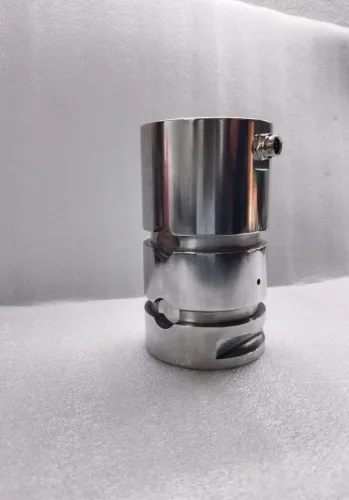
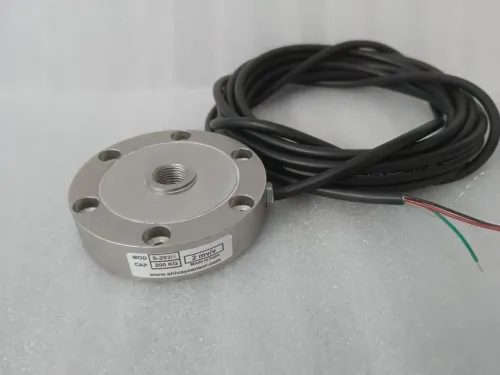
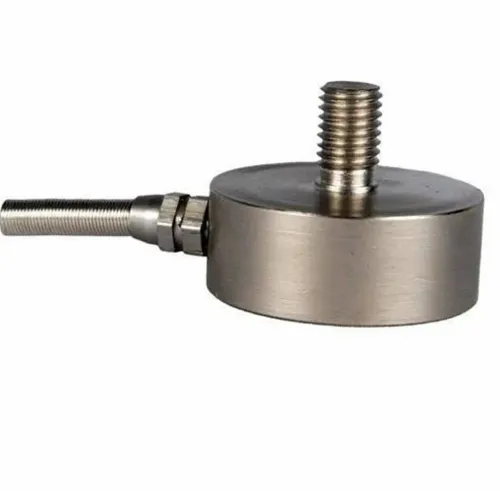
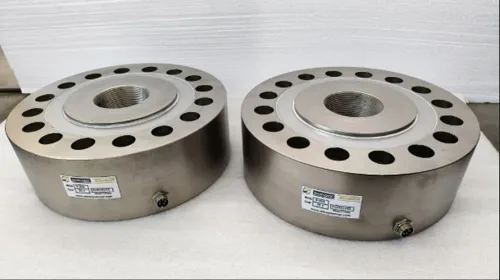
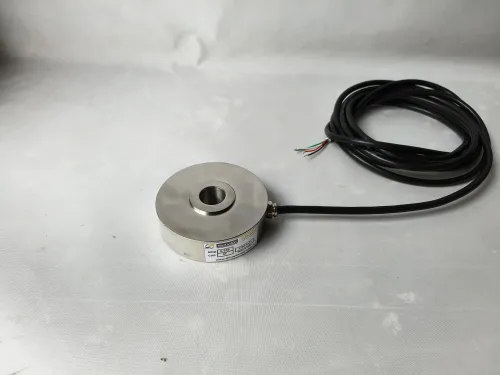
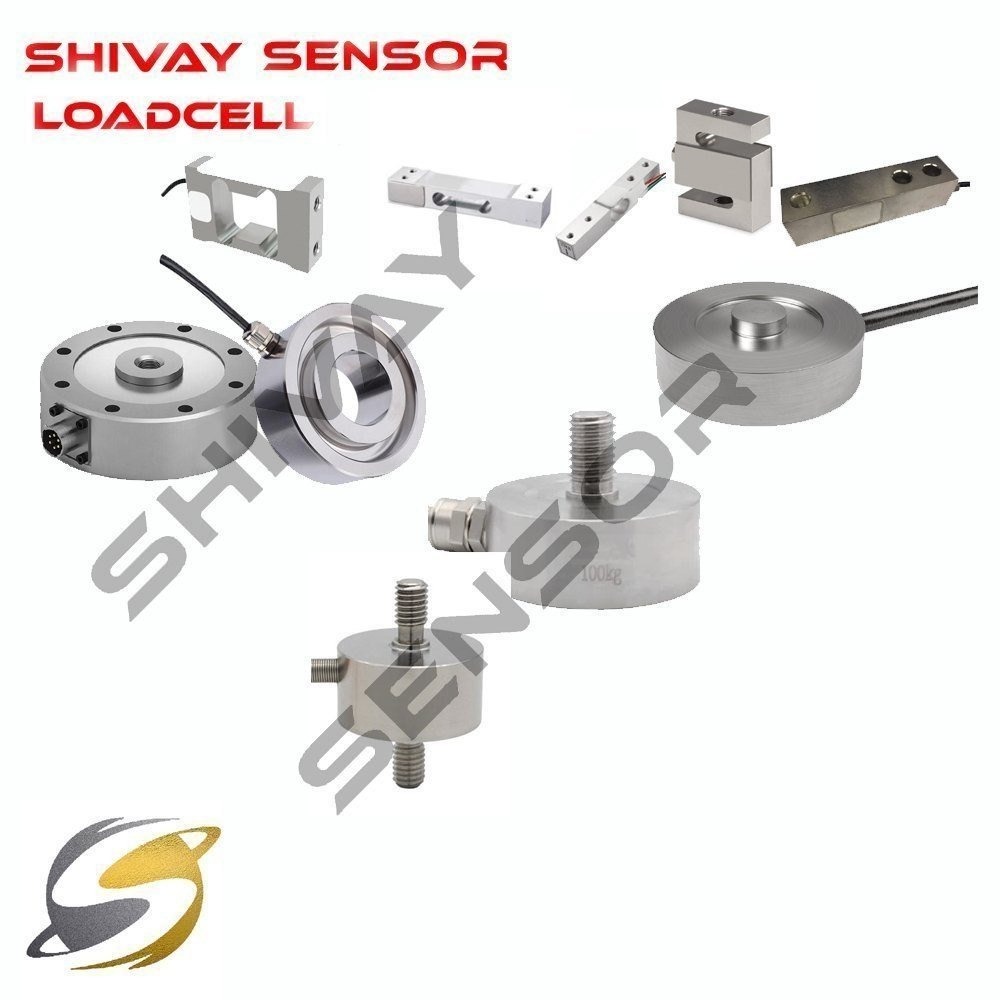
ApplicationRequired Sensor CharacteristicsCommon Sensor Form FactorRocket Engine Static Thrust TestingMega-newton capacities, multi-axis cross-talk mitigation, dynamic frequency responseMulti-Axis Pancake / Canister Load CellsSatellite Center of Gravity (CoG) & Mass PropertiesUltra-high micro-strain resolution, low hysteresis, thermal stabilityPrecision Planar Beam / Multi-Axis PlatformsSeparation Stage & Deployable MechanismsMiniature envelope, high overload margin, pyro-shock resistanceSubminiature Button Load Cells / Bolt-Force RingsFlight Control Surface ActuationFatigue-rated (>100M cycles), dual-redundant bridge circuitsIn-line Rod End / Tension LinksGimbal & Thrust Vector Control (TVC)Real-time vector monitoring, high angular load toleranceCustom Trunnion / Pin Load Cells
Engineering Custom Force Sensors: Essential Design Parameters
When designing a mission-critical force sensor for aerospace programs, engineering teams prioritize five core architectural decisions:
Material Selection
- Titanium (Ti-6Al-4V): Favored for flight-bound applications due to its high strength-to-weight ratio, low thermal expansion coefficient, and excellent corrosion resistance.
- Inconel (718 / 625): Ideal for rocket test stands, exhaust manifolds, and environments subject to extreme temperatures and corrosive propellant vapors.
- 17-4 PH Stainless Steel: Standard for static ground support equipment (GSE), mechanical rigging, and crane hoist safety systems where raw strength and fatigue resistance are primary.
Redundant Bridge Architecture
For flight hardware and critical test stands, single-point electrical failure is unacceptable. Custom aerospace load cells incorporate dual, triple, or quad-redundant Wheatstone bridge circuits bonded onto a single flexure element. These independent circuits provide parallel telemetry channels for real-time validation and failsafe backup.
Multi-Axis Force and Moment Decoupling
Real-world aerospace loads rarely occur along a single vector. Thrust vectoring, wind tunnel testing, and robotic docking mechanisms require the simultaneous measurement of forces ($F_x, F_y, F_z$) and moments ($M_x, M_y, M_z$). Custom multi-axis sensors use computational decoupling matrices to keep mechanical cross-talk below 1% full scale across all axes.
Compliance and Quality Verification Standards
Every custom sensor deployed in the space industry requires an exhaustive paper trail and validation regimen:
- AS9100 / ISO 9001: Aerospace quality management standards governing manufacturing traceability.
- MIL-STD-810 & RTCA/DO-160: Environmental engineering considerations and laboratory tests for vibration, shock, salt fog, and thermal shock.
- NIST-Traceable Calibration: Static and dynamic multi-point calibration performed under simulated vacuum, cryogenic, or high-temperature conditions.
Choosing the Right Custom Sensor Partner
Deploying load cells in space-bound hardware or launch ground systems demands engineering teams that understand orbital mechanics, material science, and cleanroom assembly.
Whether your program requires custom clevis pins for launch pad release clamps, miniature load cells embedded in satellite solar arrays, or high-capacity thrust stands for next-generation rocket engines, partnering early with custom sensor specialists reduces integration risk and accelerates flight certification.
#AerospaceEngineering #SpaceTech #LoadCells #ForceSensors #RocketTesting #SensorsAndInstrumentation #CustomSensors #SpaceIndustry
Keywords