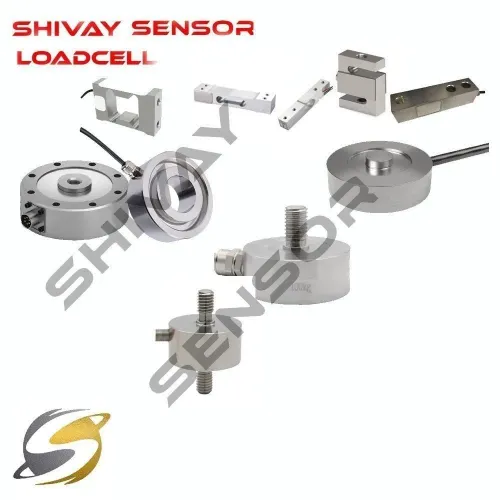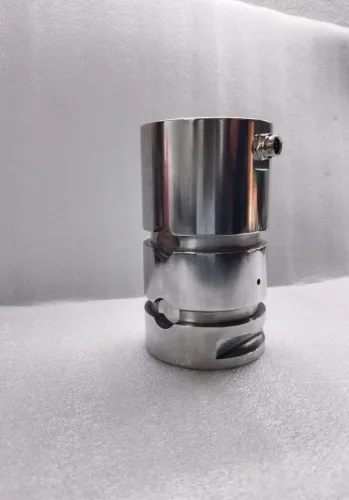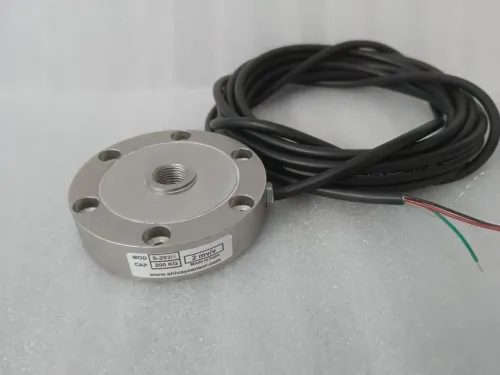
Low Profile Donut Load Cells: The Complete Guide to Bolt Tension & Force Measurement
Meta Title: Low Profile Donut Load Cells | Bolt Tension & Force Measurement
Meta Description: Discover how low profile donut load cells (through-hole load cells) measure bolt tension, clamping force, and axial loads in tight industrial spaces.
Target Keywords: low profile donut load cell, through-hole load cell, bolt tension measurement, bolt preload monitoring, force measurement sensor
Securing critical mechanical assemblies requires precise clamping force. Relying strictly on torque wrenches introduces significant error—often up to 30% variation in actual clamp force due to thread friction, lubrication variance, and surface roughness.
To achieve true, repeatable accuracy in tight clearances, design engineers and test technicians turn to low profile donut load cells (also called through-hole load cells).
Here is a practical breakdown of how low-profile donut load cells work, why direct bolt tension monitoring outperforms torque estimation, and how to select the right sensor for compact installations.
What Is a Low Profile Donut Load Cell?
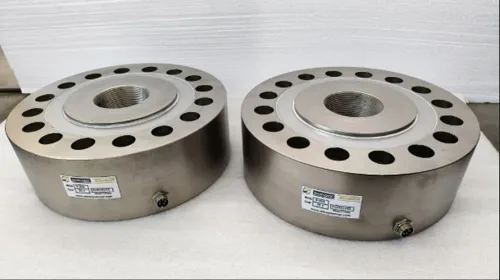
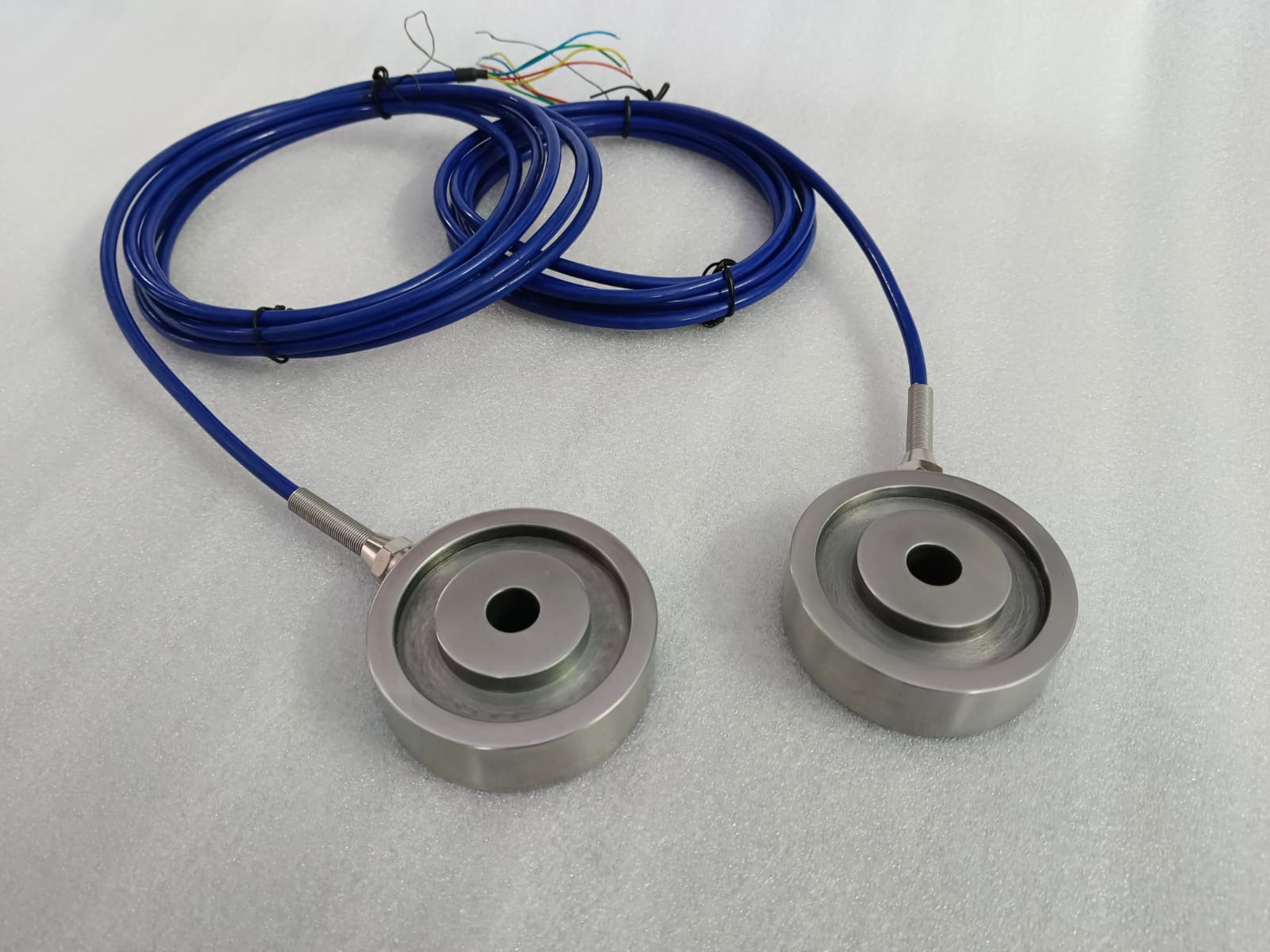
A donut load cell is a force transducer characterized by a central through-hole. This geometry allows bolts, studs, rods, or cables to pass directly through the sensor body, positioning the load-bearing element right along the axial force path.
A low-profile variant minimizes stack height (often with an overall thickness under 10–25 mm). This makes it ideal for retrofitting into assemblies where vertical clearance is limited and standard compression cells or tension links cannot fit.
Key Working Principles
- Internal Strain Gauge Architecture: High-precision foil strain gauges are bonded to an internal annular spring element inside an alloy steel, stainless steel, or aluminum housing.
- Axial Compression Measurement: As the fastener is torqued or loaded, it compresses the cell against a mating surface, altering electrical resistance in a Wheatstone bridge circuit.
- Proportional Signal Output: The sensor delivers an electrical signal (typically 1.0 to 2.0 mV/V) directly proportional to the applied clamping force.
Why Direct Bolt Tension Measurement Beats Torque
The traditional relationship between tightening torque ($T$) and bolt preload ($F$) relies on the nut factor ($K$) and bolt diameter ($d$):
$$T = K cdot d cdot F$$
The nut factor ($K$) is notoriously unpredictable. Minor shifts in surface finish, thread burrs, or anti-seize paste dramatically alter how much torque translates into actual tension versus friction loss.
MethodAccuracyFriction SensitivityReal-Time MonitoringStandard Torque Wrench$pm 25%$ to $30%$Very HighNo (Static only)Angle / Yield Tightening$pm 10%$ to $15%$ModerateNoDonut Load Cell$pm 0.5%$ to $1.0%$None (Measures force directly)Yes (Dynamic + Static)
Using a low profile donut load cell turns an educated guess into an empirical, real-time data stream.
Key Applications Across Industries
1. Bolt Preload & Structural Fastener Monitoring
In structural steel joints, bridge anchor bolts, and wind turbine tower flanges, maintaining proper bolt tension prevents cyclic fatigue failure. Donut load cells serve as continuous-monitoring washers to alert maintenance teams if bolts loosen over time.
2. Press Tooling & Clamping Force
Metal forming presses, die sets, and injection molding machinery rely on balanced clamping across tie-bars. Low profile sensors slip directly over tie-bars to confirm balanced force distribution across all four posts, preventing uneven tool wear.
3. Actuator & Hydraulic Cylinder Testing
When testing inline push-pull mechanisms, threaded hydraulic rods can feed straight through the center hole of the donut cell, providing precise inline compression measurements without altering rod travel length.
4. Aerospace & Automotive Test Benches
Engine mounts, suspension pivots, and multi-bolt wheel hub tests require high-density sensing arrays where standard load buttons add too much stack-up height. Low profile through-hole cells integrate cleanly into production test rigs.
Selection Criteria: Choosing the Right Low Profile Donut Load Cell
To ensure high accuracy and avoid premature sensor failure, evaluate these parameters before specifying a model:
1. Inner Diameter (ID) vs. Bolt Clearance
The inside diameter must provide adequate clearance for the fastener shaft while preventing the bolt threads from rubbing against the sensor wall. Lateral contact introduces parasitic side loads that corrupt measurement accuracy.
2. Washer & Hardened Bearing Plates
Donut load cells are sensitive to uneven surface contact. Always install precision-ground, hardened thrust washers between the load cell face and the rotating nut. This prevents galling and guarantees uniform, perpendicular load introduction across the annular sensing area.
3. Load Capacity & Safety Margins
Select a full-scale capacity that exceeds your target clamping force by at least 20% to 50%. Fastener torquing creates sudden dynamic peaks; headroom protects the strain gauge matrix from mechanical yield.
4. Environmental Protection (IP Ratings)
- IP65/IP67: Essential for outdoor structural or automotive chassis testing exposed to rain, oil spray, and washdown cycles.
- Stainless Steel vs. Aluminum: Choose 17-4 PH stainless steel for harsh industrial environments and fatigue-heavy applications; anodized aluminum suits lightweight aerospace test setups.
Best Practices for Installation and Accuracy
- Keep Surfaces Parallel: Ensure mounting surfaces are flat and parallel to within 0.001 to 0.002 inches ($0.025 - 0.05text{ mm}$) to avoid eccentric loading.
- Prevent Sensor Rotation: Restrain the sensor body lightly or guide the cable exit so the load cell doesn't spin while the nut is torqued.
- Calibrate In-Situ When Possible: If testing under specific temperature ranges or rigid joint conditions, an in-situ zero check and shunt calibration will yield the highest repeatability.
Summary
Low profile donut load cells eliminate the uncertainty of friction-dependent torque calculations. By integrating directly into the bolt path, they deliver direct, high-accuracy verification of clamping force, fastener preloads, and structural tension—even in the tightest spatial envelopes.
#LoadCells #ForceMeasurement #SensoryEngineering #MechanicalEngineering #StructuralHealthMonitoring #BoltTension #ConditionMonitoring #TestAndMeasurement #IndustrialAutomation
#LoadCell #ForceSensor #MechanicalDesign #EngineeringLife #IndustrialSensing #QualityAssurance #ProductTesting #BoltPreload #SensorTechnology
#LoadCells #BoltTension #ForceMeasurement #ThroughHoleLoadCell #EngineeringDesign #StructuralTesting
Keywords