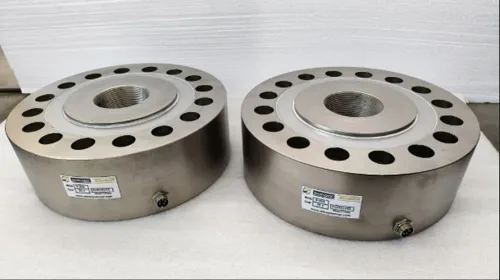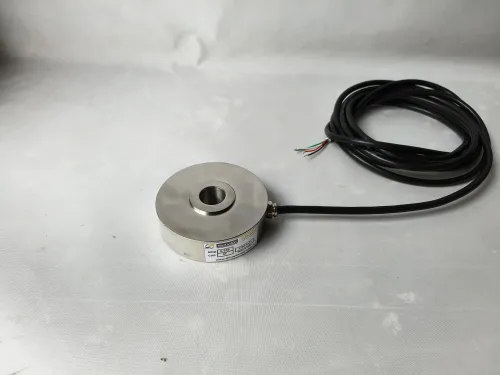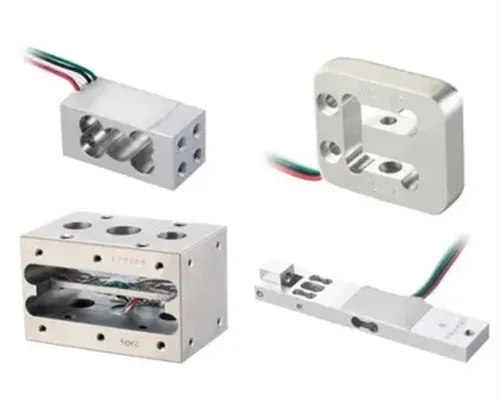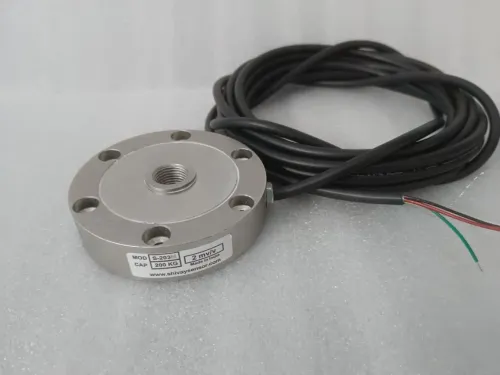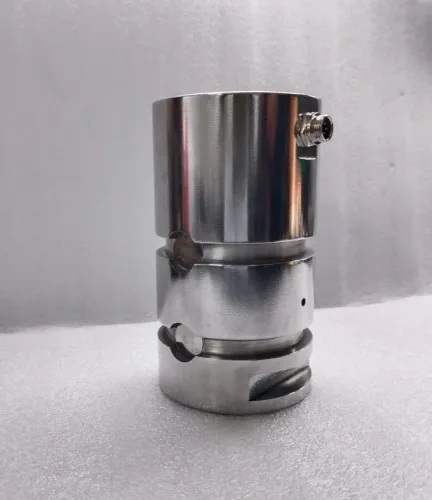
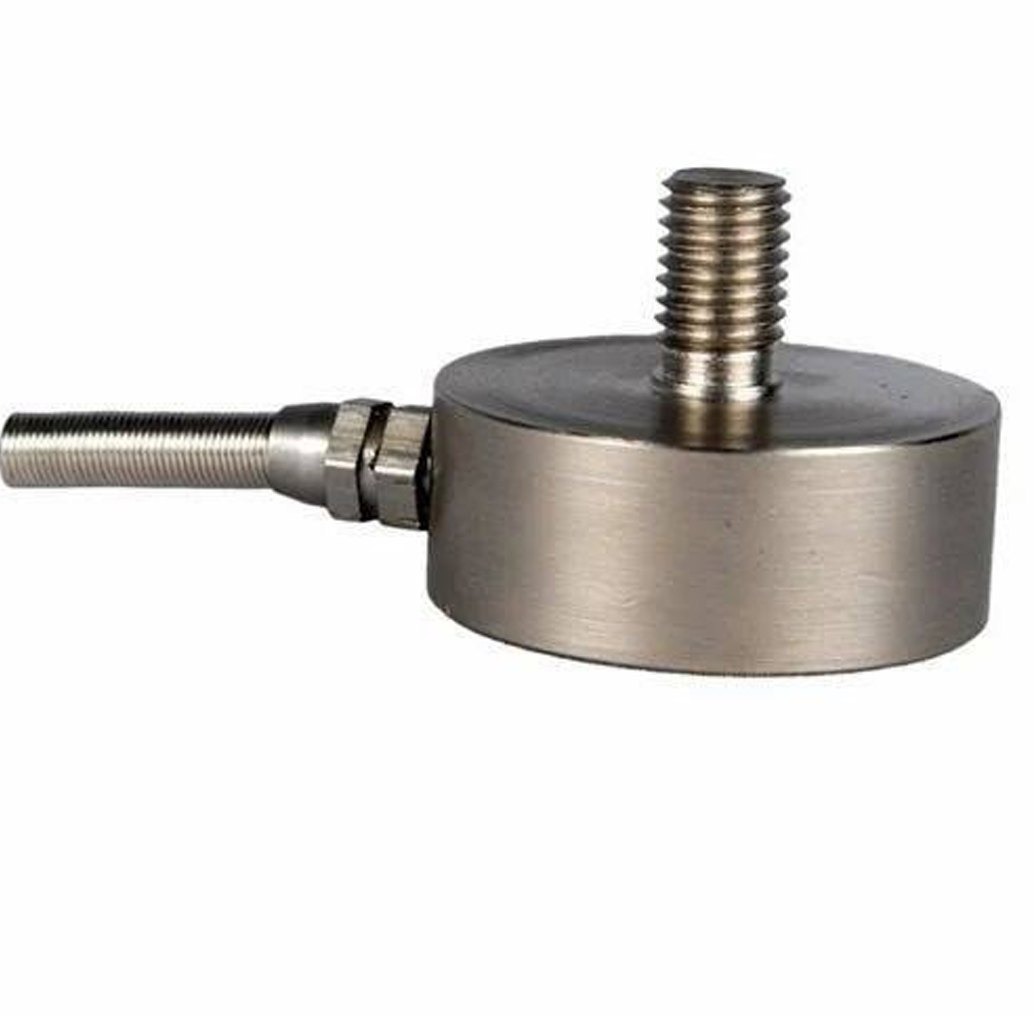
Miniature Threaded Button Load Cell | Subminiature Force Sensor
When precision force measurement is critical but installation clearances are measured in millimeters, a miniature threaded button load cell (often referred to as a subminiature force sensor) provides the ideal balance of rigidity, compactness, and high-accuracy output.
Engineered specifically for low-profile compression environments, these compact transducers incorporate integral male or female mounting threads. This design enables fast, rigid alignment in automated test fixtures, robotics, biomedical devices, and tight OEM assemblies without sacrificing mechanical stability.
Core Specifications & Engineering Highlights
- Form Factor: Low-deflection button profile with central threaded stud (male) or tapped hole (female).
- Measurement Direction: Primary compression; select models support bi-directional in-line tension/compression.
- Standard Capacities: 5 N to 50 kN (approx. 1 lbf to 10,000 lbf).
- Construction: 17-4 PH stainless steel or aircraft-grade anodized aluminum.
- Environmental Protection: IP65 to hermetically sealed IP68 options.
- Output: Standard strain gauge millivolt mV/V, with optional integrated or in-line amplified signal conditioners 0-5V, 0-10V, 4-20mA or Digital Output RS-485.
- Accuracy: Non-linearity typically $le pm 0.5%$ of Full Scale (FS); hysteresis $le pm 0.5%$ FS.
Technical Comparison: Threaded Button vs. Standard Flat Button
ParameterStandard Flat Button Load CellMiniature Threaded Button Load CellMounting StyleFree-floating or adhesive/clamp seatedDirect threaded stud / tapped mechanical couplingOff-Axis Load ResistanceLow (sensitive to side-load shifting)Moderate to high (secured centerline alignment)Footprint ProfileUltra-flat discLow-profile disc with vertical threaded interfaceInstallation SpeedRequires external retention pocketDirect torque-in installationCommon Use CasePoint-load benchtop compressionActuator push-rods, pinch force, robotic grippers
Key Industrial Applications
1. Medical Devices & Surgical Robotics
Subminiature force sensors provide tactile feedback in robotic-assisted surgery arms, catheter insertion testing, and automated syringe infusion pumps where real-time pinch force control prevents tissue damage or mechanical stalls.
2. Semiconductor & Electronics Manufacturing
Used extensively in wire-bonding equipment, pick-and-place nozzles, and wafer polishing systems to control contact forces at micro-Newton to low-Newton thresholds.
3. In-Line Actuator & Piston Monitoring
The threaded stud integrates directly into pneumatic or hydraulic cylinder rods. This allows inline verification of press-fit operations, stamping pressure, and automated crimping.
4. Aerospace & Automotive Test Benches
Ideal for multi-point switch testing, clutch pedal actuation mapping, and localized wind-tunnel structural load tracking where space constraints rule out standard S-beam or canister cells.
Best Practices for Mounting and Alignment
- Maintain True Axial Loading: Even with a secure thread, button cells are sensitive to bending moments. Ensure the applied load remains within $pm 3^circ$ of the central axis to eliminate side-loading error.
- Use a Hardened Contact Surface: When applying compression against the top load button, interface with a flat, hardened surface (minimum $50text{ HRC}$) to prevent localized indentation.
- Torque to Manufacturer Limits: Over-torquing the threaded stud during installation can induce zero-balance shifts or pre-load the internal foil strain gauges. Always use a calibrated torque wrench.
#LoadCells #ForceSensor #IndustrialAutomation #MechanicalEngineering #TestAndMeasurement #OEMDesign #Sensors #MiniatureLoadCell #MicroForceSensor #CompactDesign #PrecisionMeasurement #SurgicalRobotics #SemiconductorManufacturing #FactoryAutomation #TestingEquipment
Keywords