🔧 Static Torque Measurement Made Easy: Applications of Reaction Torque Transducers
💡 What is Static Torque Measurement?
In the world of engineering and machinery, torque is the twisting force that causes rotation. However, not all torque involves movement. Static torque measurement (often called reaction torque) is the process of precisely quantifying this twisting force when the object is stationary, not accelerating, or when measuring the force required to prevent rotation.
Unlike dynamic (rotary) torque, which measures torque on a spinning shaft, a Reaction Torque Transducer measures the equal and opposite force that a fixed object exerts to resist the applied torque—a perfect application of Newton's Third Law of Motion.
⚡️ The Advantage of Reaction Torque Sensors
Reaction torque transducers are the go-to solution for static and non-rotating applications for several key reasons:
- Superior Accuracy and Stability: Since they are not rotating, these sensors avoid the complexities of slip rings, telemetry, and inertial forces, leading to highly stable and precise readings.
- Simple, Low-Maintenance Design: They are generally less complex and more cost-effective than their rotary counterparts, requiring minimal to no maintenance.
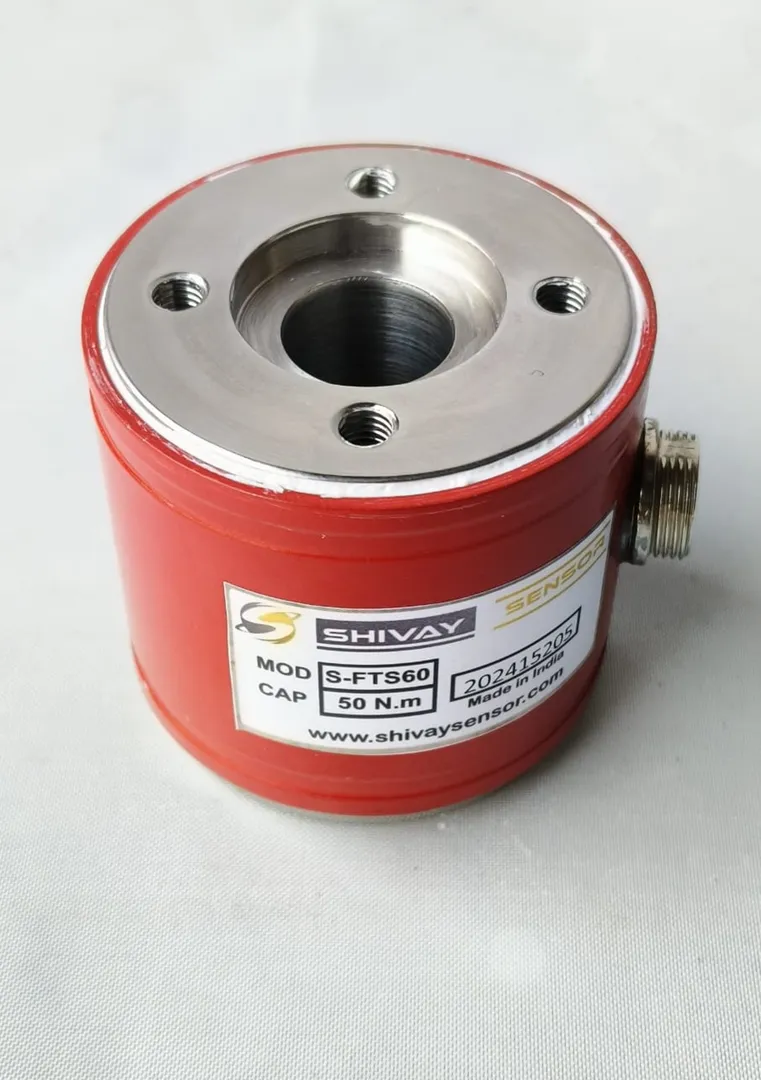
- Easy Integration: With various mounting options (flange, square drive, C-face), a reaction torque sensor is straightforward to integrate into test benches and fixed assemblies.
⚙️ Key Applications: Where Reaction Torque Transducers Excel
The reliability and simplicity of the reaction torque sensor make it indispensable across numerous industries for quality control, R&D, and process monitoring.
1. Motor and Gearbox Testing (End-of-Line QC)
- Application: Measuring the startup or stall torque of an electric motor or the efficiency and friction of a gearbox.
- Benefit: A reaction torque transducer is mounted to the housing of the motor or gearbox to measure the reaction force against the applied load, providing highly accurate performance validation before a product ships.
2. Fastener Testing and Calibration (Quality Assurance)
- Application: Calibrating torque wrenches, screwdrivers, and power tools, or performing ultimate torque tests on bolted assemblies.
- Benefit: These sensors serve as the precision reference standard, ensuring that tightening tools apply the exact specified torque, which is critical for safety in automotive, aerospace, and structural applications.
3. Viscosity and Mixing Control (Process Industries)
- Application: Monitoring the torque required by an agitator or mixer in chemical, pharmaceutical, or food processing.
- Benefit: Changes in the required torque directly indicate changes in the fluid's viscosity. The reaction torque transducer mounted to the mixer's support structure provides real-time data to monitor mixing quality or signal the start/end of a chemical reaction.
4. Hinge, Switch, and Mechanism Testing
- Application: Quantifying the breakaway torque of a high-end rotary switch, a door hinge, a control knob, or a bearing assembly.
- Benefit: Reaction torque transducers are highly sensitive, allowing engineers to measure the precise force required to initiate movement, ensuring product feel and quality consistency.
Choosing the Right Sensor: Reaction vs. Rotary
The selection process is simple:
FactorUse a Reaction Torque TransducerUse a Rotary Torque TransducerMotionStationary, non-rotating, or measuring stall torque.Continuous, dynamic rotation (e.g., driveshaft).ComplexitySimple, robust, and cost-effective.Requires slip-rings or telemetry (more complex).MeasurementThe force resisting the twist (the 'reaction').The torque transmitted by a spinning shaft.Conclusion
For any application that requires precise, stable, and repeatable measurement of twisting force without continuous rotation, the reaction torque transducer is the essential tool. Its design simplifies the complex task of static torque measurement, providing engineers with the dependable data needed to ensure quality, optimize performance, and maintain safety across virtually every industrial sector.
Ready to integrate precision static torque measurement into your application? Would you like a breakdown of the different mounting styles (e.g., flange mount, square drive) available for reaction torque transducers?
#ReactionTorqueSensor #StaticTorqueMeasurement #TorqueTransducer #PrecisionMeasurement #IndustrialSensors #TorqueSensing #EngineeringTools #QualityControl #NonRotatingTorque #TestAndMeasurement #MotorTesting #GearboxTest #StallTorque #EngineeringRND #TorqueCalibration #FastenerTesting #AssemblyLine #ProcessControl #ViscosityMeasurement #IndustrialMixer #AgitatorTorque #StaticTorqueMadeEasy: Precision with the #ReactionTorqueTransducer #TorqueSensor
Keywords